How smart contracts run explained that the ledger executes Untyped Plutus Core (UPLC), and The Cardano blockchain explained that a smart contract is a validator script guarding an output. This page connects the two: how Plinth source becomes UPLC, how that UPLC is packaged, and how it finally reaches a transaction.
The single most useful thing to understand is where the UPLC boundary lies. Turning Haskell into UPLC is Plinth’s job and Plinth’s alone. Everything after UPLC — serialising it, describing it with a blueprint, hashing it into an address, and attaching it to a transaction — is shared Cardano infrastructure that works identically for any UPLC, no matter which language produced it. The ledger only ever sees opaque UPLC; it neither knows nor cares that it came from Plinth.
The big picture
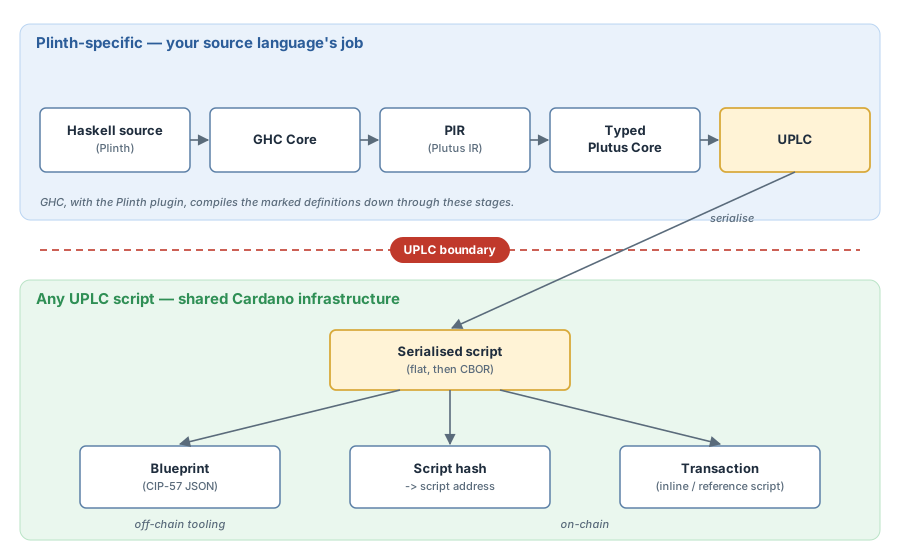
Above the boundary is language-specific. Below the boundary is where other languages — Plutarch, Aiken, OpShin, and the rest — converge: they reach UPLC by different routes, but from there they all use exactly the same machinery shown below.
Compiling to UPLC (Plinth-specific)
Plinth is a subset of Haskell, so it is compiled by GHC. A GHC plugin intercepts the definitions marked for on-chain use and takes them down a pipeline of progressively lower-level representations:
- GHC Core — the ordinary intermediate language GHC already uses. The plugin reads the Core that GHC produced for the marked definitions.
- PIR (Plutus IR) — a Plutus-level intermediate representation that
still has high-level conveniences such as datatypes and
letbindings. - Typed Plutus Core — PIR compiled down to the typed core language.
- UPLC — the types are then erased, leaving the untyped program the ledger actually runs.
The result is wrapped in a CompiledCode value (the program, plus the PIR kept
around for debugging). This whole pipeline is the only Plinth-specific part of
the story. Because the plugin is built into plinthc, compiling a module that
defines Plinth code yields this UPLC alongside the usual GHC outputs — see
plinthc.
Serialising the script (generic)
A UPLC program is an in-memory term; to store, hash, or transmit it, it has to become bytes. Two steps turn it into the serialised script:
- flat — a compact, bit-level binary encoding of the UPLC term.
- CBOR — the flat bytes are then wrapped in CBOR.
Those CBOR bytes are “the script” as far as the ledger is concerned: it is what gets hashed and what a node ultimately deserialises and runs. None of this depends on the source language.
You will also see scripts on disk as a .plutus file. That is just a small
JSON text envelope — { "type": ..., "description": ..., "cborHex": ... }
— used by cardano-cli and cardano-api to carry the CBOR bytes around.
It is a transport wrapper, nothing more.
What a blueprint is (CIP-57)
A blueprint is not something the ledger consumes. It is an off-chain, machine-readable description of a contract, standardised as CIP-57. A blueprint is a JSON document that bundles:
- the serialised UPLC (as CBOR hex) — the same bytes from the previous section, and
- metadata: each validator’s purpose and the schemas of the data it expects — its datum, redeemer, and any compile-time parameters.
It exists because off-chain code — wallets, dApp backends, cardano-cli
— needs two things to use a script: the script’s bytes, and a precise
description of how to build the data the script expects. The blueprint is that
machine-readable interface.
Crucially, CIP-57 is language-agnostic: it is a Cardano-wide standard, and tools for other languages (Aiken, for instance) emit blueprints too. What is Plinth-specific is only the library and generator programs that produce one.
For a closer look at what a blueprint contains, how it is produced and used, and where its limits lie, see Contract blueprints.
Script hash and script address (generic)
A script is identified by its script hash: a blake2b-224 hash of the serialised script, prefixed by a tag for its Plutus language version (below). The hash is purely a function of the bytes.
Placing that hash in the payment credential of a Cardano address yields a script address. Funds sent to a script address are guarded by the corresponding script: any transaction trying to spend them must satisfy the validator. For a minting policy, the same hash serves as the policy id that namespaces the tokens it governs.
Plutus ledger languages (generic)
The ledger distinguishes Plutus script versions — V1, V2, V3. The version is tagged at the bytes level and determines which built-in functions are available and the exact shape of the script context a validator receives. It is part of the shared infrastructure, independent of the source language; Plinth simply targets one of these versions.
Attaching a script to a transaction (generic)
To validate a transaction, a node needs the actual script bytes. There are two ways to supply them:
- Inline in the witness set — the serialised script travels inside the transaction that uses it.
- Reference script — the script is stored once in an output and later transactions point at that output to reuse it, without re-transmitting the bytes. This keeps transactions small when a script is used repeatedly.
When the script then runs, it receives the runtime inputs described in The Cardano blockchain: the datum attached to the output being spent, the redeemer supplied by the transaction, and the script context — the ledger’s view of the transaction. (A minting policy is invoked with a redeemer and context but no datum.)
All of this is generic. The ledger handles the script as opaque UPLC; the mechanics of inline versus reference scripts, of datum and redeemer and context, are the same whether the bytes came from Plinth or any other compiler.
The dividing line
So the pipeline has a clean seam. Above the UPLC boundary is Plinth: Haskell source compiled, via PIR and typed Plutus Core, down to UPLC. Below it is the rest of Cardano: serialisation, blueprints, hashing, addresses, and transactions — a shared substrate that every UPLC-producing language plugs into the same way. Plinth’s responsibility ends precisely where the UPLC begins.
Further reading
- How smart contracts run: Plutus Core and the CEK machine — what UPLC is and how the ledger executes it.
- The Cardano blockchain — the eUTXO model, validators, datum, redeemer, and script context.
- Languages for smart contracts — the other languages that converge on UPLC.
- Your first smart contract with Plinth — compile a validator and generate its blueprint, hands-on.
- Lock and unlock funds on a local chain — walk this whole path with commands: envelope, script address, and the two transactions, on a local devnet.
- CIP-57: Plutus contract blueprints — the blueprint standard.